
Links for Supporters
Looking for the Proofreadaloud? It’s here.
Looking for last week’s Early Access Feature? It’s already in General Access here.
It’s About Time (Part II): The Tension Clock
I’m skipping the big preamble today. Today is all about giving you game mechanics and instructions for using them. Besides, I already did the preamble.
Today, I’m going to teach you how to use Tension Clocks to track time in your fantasy adventure roleplaying games and to make players aware of its passage. If you’re a long-time Angry fan, today’s system is meant to replace my old Tension Pool, but, really, you can think of the Tension Pool as the simpler, more casual variant of the Tension Clock system if you don’t want Tension Clock levels of detail.
If you have no idea what I’m talking about, don’t sweat it. These rules are totally self-contained.
By itself, the Tension Clock just keeps time, but it works in conjunction with my Adventure Complication system, which I’ll be sharing fully in two weeks. At least, if you’re a supporter with Early Access, you should see it within the next two calendar weeks. It might take a little longer to get out to the General Access audience.
Moreover, this Tension Clock thing is actually the anchor point for numerous other game mechanics I’ll be sharing over the next few months that’ll help you better handle different aspects of dungeon delving, wilderness trekking, and town dicking arounding. In fact, I’ve basically mapped every conceivable thing, from wilderness travel to searching to downtime activities to resting onto these clocks so the Tension Clock becomes as core to action resolution as Ability Checks. So, keep that in mind before you say, “Wait, that’s it?” Because, yeah, this really does seem like it’s just the Tension Pool with a tracker.
It’s not.
But that’s all future content. For today, let me teach you how to track time in your fantasy adventure roleplaying game, how to make time matter, and how to make the players give a crap about it.
The Tension Clock(s)
The Tension Clock is a timekeeping system. It helps you track the passage of time at your table, and it helps the players see time passing. When used in conjunction with Adventure Complications, it encourages players to treat time like a resource, and it differentiates slow and careful play from big-risk, big-reward play. It doesn’t make one better than the other, though. Game situations do that. It just makes the two approaches actually different.
To use the Tension Clock timekeeping system, you’ll need to display a Tension Clock at all times on your physical or virtual table. Here’s what they look like…
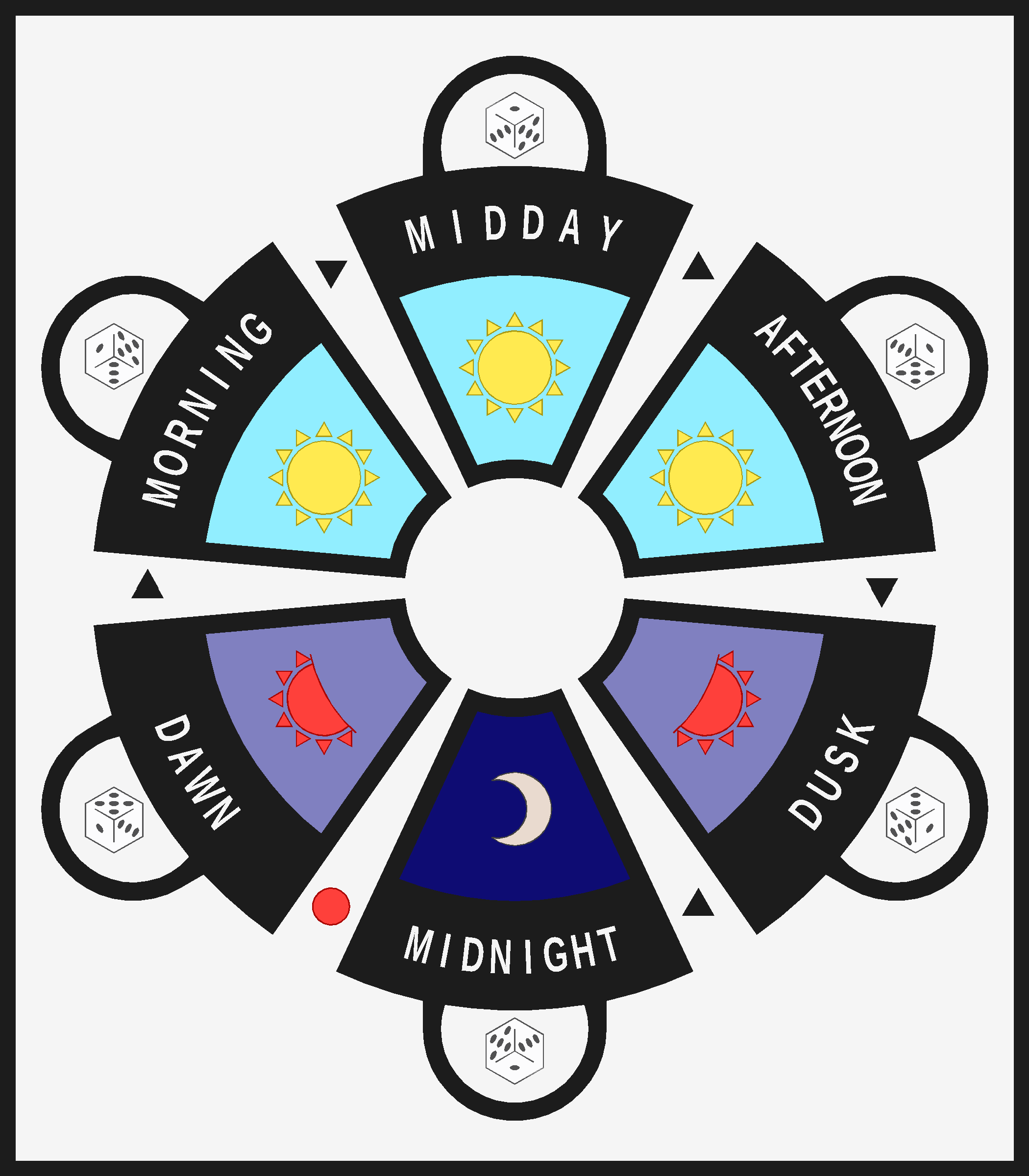
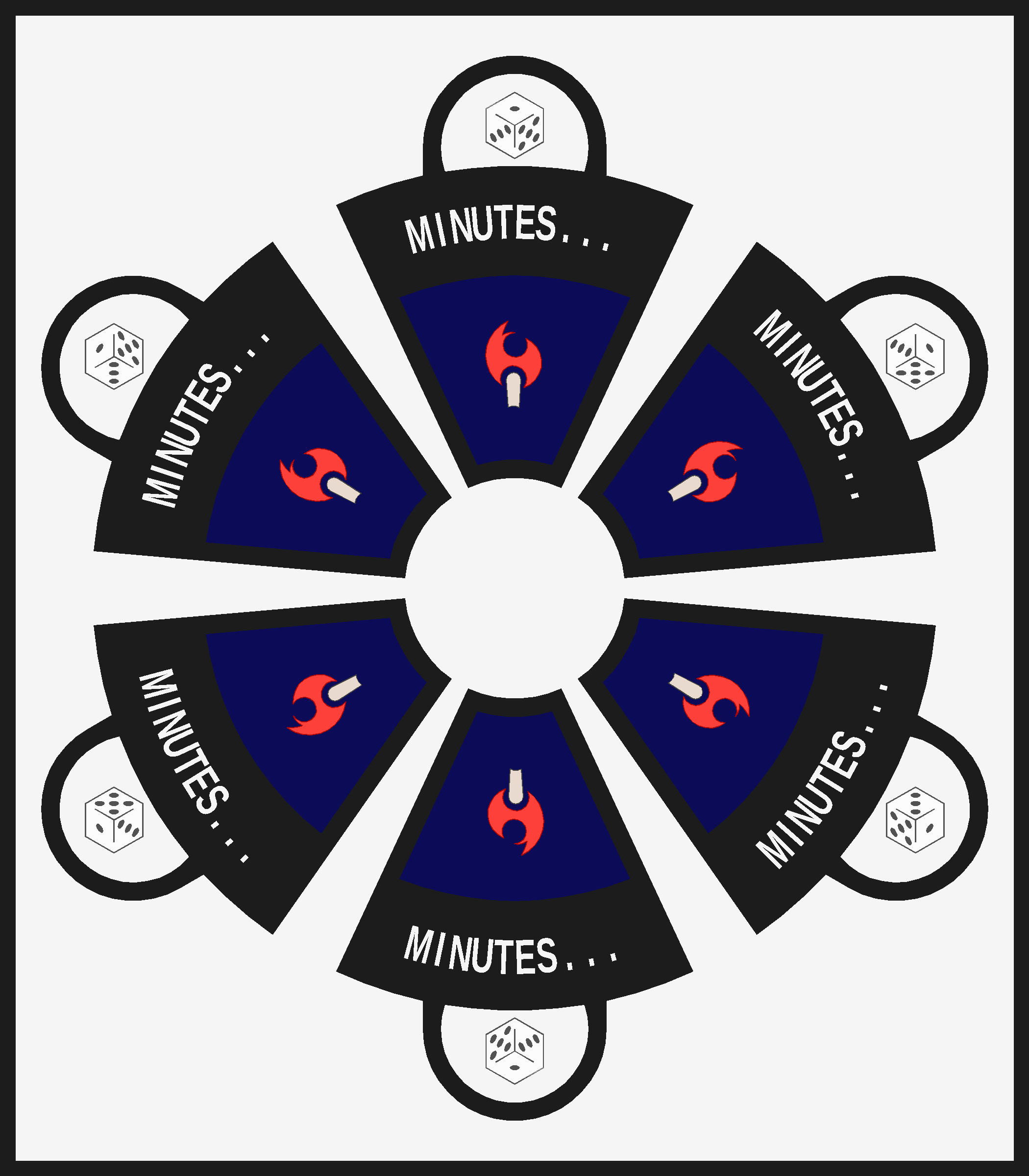
Here are some download links. The printable version combines both clocks on one page, prints at 300 DPI, and is sized so a standard six-sided die or one-inch token fits onto the tracking spaces. The digital versions are for importing into a virtual tabletop. They’re sized so a 50-pixel token, which is pretty standard, fits nicely on the tracking spaces.
Download the printable Tension Clocks as a PDF.
Download the digital Delve Clock as a PNG.
Download the digital Daily Clock as a PNG.
Now, I know those clocks are pretty ugly. I’m a game designer, not a graphic artist. Well, I’m a former accountant turned up-jumped blogger pretending to be a game designer. That said, I am working on some nice gifts for my generous supporters. Prettier clocks with special variant rules for seasonal daylight variation. They’re basically polished versions of the more detailed clocks I use in my home game. Expect them to appear on Patreon and SubscribeStar for Angrican-tier supporters in the next week.
Thanks for your support, folks.
Anyway…
Now that you have the clocks, how do you use them?
Timekeeping with the Tension Clocks
As I said, you must always have a Tension Clock visible on your table. Visible to you and visible to your players. See, the clocks represent the players’ characters’ perception of the passage of time, and that wording ain’t accidental. I’ll get back to that, though. Players have to be able to see them, and there’s nothing on them players shouldn’t see. Which is why you don’t ever display both.
There is only ever one active Tension Clock.
The pretty Tension Clock with the colors and the suns and moons? I call that the Daily Clock. But I also call it the Wilderness Clock, the Town Clock, or the Hours-and-Days Clock. It tracks time across a single in-game day. It’s divided into six segments of a few hours each called Watches. Yes, there is a reason I said, “a few hours,” and not “four hours.” I’ll get to that.
The Watches are supposed to do the whole diegesis thing. The six Watches: Dawn, Morning, Afternoon, and so on, represent the way the people in the world mark time. In bigger settlements, bells ring out the Passing of the Watches so guards can rotate, priests can pray, and all that horseshit. You can change the names if you want and even change them by region or culture. In my world, they’re called Bells, not Watches, and have names, at least in the Western Kingdoms, like Lark’s Bell and Wolf’s Bell.
The dark Tension Clock with the torch symbols that’s ominously labeled minutes, dot, dot, dot? That’s the Delve Clock or the Minutes-and-Hours Clock. It tracks the passage of about one in-world hour and is divided into six several-minute segments. Again, the vagueness is a purposeful feature, not a bug.
So, you display the clock based on the current scene. If the characters are doing moment-to-moment gameplay in an indoor or underground area, you use the Delve Clock. Technically, you use it even if they are doing minute-to-minute gameplay in an outdoor area. Just ignore the lighting indicator in that case. If the characters might take activities that take several hours, you use the Daily Clock, even if some minute-to-minute gameplay is mixed in. For example, when the players are in town, they might spend the morning shopping, crafting, carousing, or whatever, but mixed in, you might play a moment-to-moment encounter or conversation. You don’t have to change clocks for that. Those small interactions just don’t take any significant time.
Around the outside of the Tension Clock are little spaces for Tension Dice. As time passes, you place six-sided dice or tokens there to mark the passage of time. Glancing at the Daily Clock will tell you what time of day it currently is. Glancing at the Delve Clock tells you roughly how much time remains before an hour will have passed since the last time an hour passed. That’s vague on purpose, and there is a reason there’s no way to count the hours on the Tension Clock. Working as intended, kids.
When the players take a Time-Consuming action, you add a Tension Die to the Tension Clock. What’s Time-Consuming? It’s anything that takes several minutes when Delving or a few hours on the Daily Clock. I’ll talk more about how to adjudicate actions using this framework very soon, but also note that I will gradually be mapping a lot of stuff to this system for your convenient use. You’re going to have to use your own judgment to fill in the blanks for now.
If the players take a Risky action for the scene, you pick up all the Tension Dice currently on the clock and roll them secretly. If any of the dice show a 1, you make a note that a Coomplication is imminent, and then you replace the Tension Dice on the clock. What’s Risky? Again, I have a lot of notes to share and ways to map this to in-game actions, but it’s basically anything that’s a high-risk, high-reward gambit, a quick-and-dirty solution, or anything likely to attract unwanted attention or bring consequences. Forcing doors, for example, traveling during the twilight hours, traveling through controlled hostile terrain in the wilderness, raising a ruckus in town, that kind of thing.
If the players do something that’s both Time-Consuming and Risky, you add a Tension Die to the Tension Clock, then roll the dice secretly to see if a Complication approacheth, then replace the dice on the clock.
When the Tension Clock is full of Tension Dice, you clear it by rolling all the Tension Dice secretly, noting if you see any ones so you can chamber a Complication, then you put the dice aside. A new Delve hour or Daily day has started.
Note, by the way, that days start sensibly with the Dawn Watch, not at midnight. There’s a little stop indicator on the Daily Clock to tell you where it resets.
That’s it. It really is just the Tension Pool with a clock tracker. Except it’s not. It’s also a tool for action adjudication and an anchor for a lot of game mechanics that improve the parts of the game that really need time-tracking the most. I’ll get to all of that in future articles.
But I’m not going to quit here. First, I want to explain and clarify a few things so you don’t use my Tension Clocks wrong and screw them up. Then I’m going to close. But I’ll be back almost immediately, like next Feature immediately, to talk about adjudicating actions on the Tension Clock and to explain some more detailed rules like switching Tension Clocks as scenes change, resting, and handling uneventful days. Then, in a couple of weeks, I’ll be ready to share the whole Adventure Complication system.
So, let’s do it.
The Three Rules of Not Screwing Up My Tension Clocks
If you want my Tension Clocks to work, there are three things you have to understand. If you don’t, you’ll use them wrong, and that’ll void your warranty. Keep in mind this whole Tension thing, both the old Tension Pool and the current Tension Clocks are the result of years of field testing. Not just my own, either. Thousands of tables have now used the Tension Pool rules over the years, and I’ve gotten an asston of feedback. I’ve been using Tension Clocks myself for a long time, and I’ve let lots of others test them out too.
Rule the First: It’s Vague Because It Needs to Be
The Tension Clocks do not track the passage of actual, objective time measured to the exact minute. I mean, they do track actual time passing, but filtered through the perceptions of people living in the fantasy world in which the time is passing. There are precise clocks in the world, of course, in astronomy towers and temples to anal-retentive gods, but most of the world doesn’t care that much about precision and doesn’t have to. It’s basically all about daylight. When you’re not under the sky, you don’t have a watch, and the human sense of time is piss-poor when you take away external cues.
Hence time is measured in rough increments, but that’s okay because absolutely nothing in fantasy adventure roleplaying games demands any more precision than that. At least, nothing should. Because measuring time at the table is a giant pain in the ass. So, if you tell me that in your game, in your world, the precise, objective passage of time to the exact minute matters because of this deity or that magical effect, I’m going to call you an idiot for building worldlore that demands precision timekeeping. That’s your fault. Don’t do that.
Note, also, that we glaze over a lot of shit. Yeah, it’s easy to imagine lockpicking as this minute-long thing, but that’s assuming a video game character stands next to a door playing a lockpicking animation while you hold the interact button. In actual reality, there’s a whole rigmarole. People jockeying out to the rogue’s way, the rogue kneeling down, someone bringing over a candle because a torch held close to someone’s face will just burn their eyeballs out, the rogue pulling out and unfolding his little tool case, selecting a couple of tools, making some experimental pokes, putting those tools away and selecting different tools, the candle-holder’s attention drifting, the rogue yelling at him, the rogue pausing to wipe sweat from his brow that’s stinging his eyes or shifting because kneeling on a dungeon floor is crampy work, then, finally, there’s a click, and the rogue replaces all his tools, folds them up, puts them away, stands up, dusts his knees off, stretches, the candle-holder extinguishes the candle, puts it away, the party jockeys around getting ready to open the door, and so on. Even if the rogue only wiggles his thing in the lock’s hole for a minute or two, there’s five minutes of dead time around it.
So everything takes longer than it does, and nothing takes precisely the same amount of time as the last time. As I show you how I’ve mapped mechanics to the Tension Clock, you’ll see how much variability I’ve added into stuff to make it hard to predict just how much you’ll get out of a minute or how long a task will really take.
Even the things that seem like precise timekeepers aren’t. Torches and candles don’t really burn for exactly 3,600 seconds and then die, and there’s no reason to assume light spells are running on atomic clocks either. Isn’t magic a chaotic force of transformation that defies physics? Shouldn’t it be a little, you know, wonky?
Yeah, don’t answer. Your answer is stupid and wrong. Once again, the correct answer is the one that makes gameplay work. Time, as a game mechanic in a fantasy world, works best when it’s vague and wibbly-wobbly, so why the hell would you come up with an arbitrary lore explanation for magic that demands to-the-second precision? That’s just a stupid-ass call.
Which, also, is why your calendar is made around timekeeping needs and the worldlore comes second. It is therefore mathematically provable that the correct calendar for a fantasy world consists of ten six-week months with six-day weeks, four months of summer, three of winter, and two months each of autumn and spring. You can also have three months each of winter and summer and two months each for autumn and spring. That is also a valid mathematical solution. But those are the only two roots of the equation. If you disagree, you’re denying the science.
Anyway…
The Tension Clocks are only as precise as they need to be. Inaccuracies average out over time. A day is a day, but daylight isn’t a switch, so if the party happens to squeeze what might technically be five hours of activity into an afternoon, there are all sorts of ways to explain that without having to conclude that space-time broke. It doesn’t matter whether picking a lock took six minutes or 11 or whether the hour was technically only 53 minutes. It’s all close enough to do what it needs to do, and there’s enough space for inconsistencies in how reality works to cover it all.
So, don’t say ten minutes, say several minutes. The Watches are a few hours long. Approximately an hour has passed. Torches gutter early sometimes and light spells sometimes linger. That’s how it be.
Next rule.
Rule the Second: Metagaming is a Feature
Remember how I said the Tension Clocks don’t model time; they model the perception of time? Remember my long preamble where I went off on a whole stupid thing about how people experience time stress differently in different circumstances and based on their own personal awareness of and tolerance for time stress? Well, I’ve baked that psychology into the system. That’s why it’s called the Tension Clock system. It’s meant to make players tense. Or, more precisely, it’s meant to create tension in the players’ minds over how they, as a group, spend their time.
Lots of players will get more tense as the clock fills. They’ll start worrying both about taking Time-Consuming actions and avoiding Risky actions. Some players will take more Risky actions when the Tension Clock is fresh. Players might even wait out the clock before taking a Risky action. You might think that’s gamey and fakey, but it’s not. It actually reflects through a murky mirror how the characters are thinking about time, especially in the face of how long they think it’s been since something went wrong or how long things have been going smoothly. Because those things actually change stress levels and risk tolerance.
Even waiting for the clock to change before doing something dangerous, which seems super metagamey, actually mirrors a real human behavior. Many humans in tense situations, before they take a dangerous action, will pause or freeze up waiting to see if the situation really is safe enough to take a risk. So, yeah, the party saying, “Let’s just stay still for a bit and be carefully attentive for a few minutes to make sure nothing terrible is about to happen before we make a ton of noise smashing through this door,” is a normal, human behavior, even if it’s actually ludicrously irrational. It’s how our sympathetic nervous systems are wired and managed.
So, yeah, the characters wouldn’t ever say, “The Tension Clock is almost full; we absolutely shouldn’t smash this door down.” But while the players say that, the characters would say something like, “We’re pushing our luck. We’ve been down here a long time, and we’ve managed to avoid drawing any attention to ourselves. We need to be careful because our luck is going to run out eventually.” Same stress, same emotions, different words.
However, the most important thing to remember here is that the Tension Clock system doesn’t break under metagaming. It works fine whether the players engage reasonably with it, metagame it, or even ignore it. Letting the clock fill has consequences. Taking risky actions has consequences. Complications are inevitable anyway. Efficiency is a good strategy, but it’s not a perfect strategy, and high-risk, high-reward gambits taken prudently can pay off. Which is why I didn’t say “rewarded” or “punished” and I never will. It’s also why I started referring to actions as Risky instead of Reckless. Reckless sounds bad; Risky sounds like a choice.
In short, the metagaming is a genius feature, not me stupidly missing a bug, so get off my case.
Rule the Third: Don’t Screw with the Tension Clock
I get it. I’m a DIY gamer and a consummate hacker. I tinker, play, and make things my own, and I encourage others to do the same. So please take me seriously when I say, “Don’t screw with these mechanics.”
Don’t add to or change the rules of the Tension Clock itself. Don’t add variable dice sizes. Don’t create game effects that add or remove dice. Don’t modify the clock to fit your dumbass timekeeping lore which demands a part of every day or week where the Tension Clock can’t hurt you because of the cosmic order. Use the Tension Clock exactly as I described it.
Years ago, the original Tension Pool was more complicated. Through feedback and my own experiments, I gradually pared away every overcomplicating element that did nothing. That’s how this crap works. You build a mechanic, then you put it in a crucible and burn away all the dross until you’re left with the smallest, simplest mechanic that does its job. The Tension Clock is the result of that process. It’s simple enough that you can keep all the rules in your head. “Display a clock, Add a Die for Time-Consuming actions, Roll the Dice for Risky Actions, Roll and Clear the Dice when the Clock is full, any 1 indicates a Complication.”
Why not make mechanics that play with the clock? Bards that can defuse Tension with a song? Chaos demons that can roll the Tension Dice? Because that isn’t how time works and, even though the Tension Clock is about how time is perceived, it’s still based on time. Time is an inevitable, ceaseless, merciless bitch. Time is the fire in which we burn. We are always running out of time. You can filter time through perception, but you can’t stop time from being time. Don’t.
Besides: Inertia.
Now, the mathematically inclined among you may have noticed that every Delve Clock hour and Daily Clock day carries a 65.5% chance of a Complication arising. Basically, every three hours or every three days, you get two random encounters or incidents. That might seem a bit high to some of you. It actually is. Meanwhile, others of you might wonder if the odds of Complications arising shouldn’t vary by the dangerousness of the area. Surely some wilderness regions are more hostile than others. Surely some dungeons are more dangerous.
Well, fret not, for Angry has you covered. That 65.5% chance isn’t quite what you think it is. The odds of a meaningful Complication actually range from about 37% to 55% depending on the scene. It’s just that I built the difficulty slider and an adjustment factor into the Adventure Complication system.
I won’t make you wait a few weeks for that, though…
Next: Action Adjudication and Advanced Tension Clock Usage
In my very next Feature, coming very soon to Early Access folks and next week if you’re reading this in General Access, I’m going to talk you through some basic action adjudication guidelines you can use in normal situations so you don’t have to wait until I write an entire system for searching, wilderness trekking, or crafting to use the Tension Clock. I’m also going to cover rules like switching between clocks, handling rests, and dealing with long stretches of uneventful gameplay without having to resolve everything in several-minute or few-hour chunks. Sometimes you just want to handle a couple of days of travel all in one go, right?
In addition, I’ll give you some basic guidelines for Complications of the Random Encounter variety so you don’t have to wait for more advanced Complication rules. Random Encounters are the most common and most exciting kinds of Complications anyway. Even in nonhostile environments, you can have a Random Encounter. It’s just with an obnoxious bard or pickpocket instead of an ogre or a green slime, right?
So stay tuned for that.
I love the graphical aspect of the clock! I think the glass bowl was a bit vague (or I wasn’t using it correctly) for my players. I can’t wait for the guidance on complications, which was where I felt the weakest.
Thank you for the long-awaited revision! Very excited for all the future hacks this will enable
So previously, you suggested expiring 1-hour long benefits at the top of the hour (when the Tension Clock is cleared) regardless of when they are cast. Is that still the case? Or would they expire when a dice is placed on the segment it was cast (six segments after the spell was cast)? Totally understand that an hour is a rough measurement and it doesn’t really matter if an hour-long summon lasts for 50 minutes or an hour and ten. My players WOULD be annoyed if their hour-long summon only lasted 2 segments on the clock.
Granted, maybe it does make sense in-character (“let’s prepare while things are quiet”) and out-of-character (“let’s get the most playtime out of the spell”). But the way I’m going to describe this system changes if it’s the top-of-the-hour kind or the 6-segment kind. And if its a “stay tuned for the answer…” I’m more than happy to wait.
You can’t just drop a single paragraph about mathematically correct fantasy calendars and then walk away.
I’m fairly sure that he can in fact do that.
I’ll give you my guess. He’s doing time in groups of six of the smaller increment for this, six days to a week allows the possibility of a week clock for more prolonged downtime like when you’re in Rivendale waiting for Frodo to wake up. Six weeks to a month allows for the possibility of a month clock for when you’re forging the sword of ultimate power that takes a year or so to make or when you’re checking for complications in your character’s/character’s wife’s pregnancy. Ten months to a year allows for a year of roughly the length we’re used to and lets our intuition about seasons work reasonably well and lets you change out the weather and agricultural activities as time passes in the gameworld.